Withering Away in the Winds
- Joe Kennedy
- Dec 21, 2022
- 29 min read
Updated: Dec 11, 2025
In late July 2022, Isaac & I set off towards the Wind River Range in Wyoming for a trip to the Cirque of the Towers. After spending a handful of "Alpine Tuesdays" together (days we both had off all summer long) in the Rocky Mountains getting acclimated and having some big days out in the mountains, we were ultra-psyched to get after it in The Winds. We had some objectives in mind and a few must-do's, but we were mostly looking forward to getting out into the backcountry in new mountain range for an extended trip of romping & ripping. On to the details...

Day 1: Hike in, get psyched!
After a long drive listening to Tooth & Claw, chatting for hours about our plans, and driving down the seemingly endless dirt roads, we finally arrived at the Big Sandy trailhead. It was packed: tons of cars parked and people out and about finalizing their packing -- an unexpected scene given the long drive through an open landscape and quiet roads. Isaac recognized someone when we stepped out of the car (someone he'd been on rafting trip with in California, I think), and we all chatted for a while about the rad place we were all about to hike into. We had packed our bags back in Boulder to prepare for a quick turnaround, so after a little stretch & a snack we started the hike out. We were looking at around 7.5 miles and 1,600 feet of elevation gain to get to the lake at the base of Warbonnet Peak, the first of many summits we hoped to reach. Even with heavy packs, the trail wasn't exceptionally difficult on the body: gradual uphills (minus one brutal climb), a light rain, and moderate temperatures made the incredible views all the more enjoyable. What we weren't mentally prepared for were the mosquitos...

The guidebook and the people of the internet claimed that the mid-summer bugs were a thing of nightmares, so we came prepared with bug nets as protection. It was feeling humid and sticky with the light rain and our mid-day start time: wearing extra layers to cover all exposed skin seemed pretty uncomfortable and we opted to start off in shorts and t-shirts. How bad could these mosquitos really be? Turns out they can be pretty horrendous. Not long after starting off, they started to show up. First a little buzz in the ear and a pinch on the neck, but it quickly changed. The hot sun tends to force the mosquitos into hiding, but the light rain left the skies in a gloomy, shadowed state: the perfect conditions for the blood suckers to swarm. These little beasts were some of the most antagonizing creatures I've experienced in life thus far. Neck, legs, arms, and ears. They were suddenly everywhere. Isaac was hiking in front of me for a long section, both of us trying to muster up that deep Zen mindset where we could simply ignore the buzzing & biting, settling in to the rhythm of the trail. The only rhythm I was able to find was the repetitive motion of alternating the arm used for swatting each body part. Leg, leg, arm, arm, neck. There were hundreds, thousands of these things flying around us. Every swat and swipe would send 15-20 mosquitos away, but even though we probably squashed 20 every minute they continued to attack in full force. We honestly didn't talk much for a long while.

Similar to strong emotions like new love, unfounded anxiety, or a smell that brings up an old memory, it is hard to put this misery into words that do the feeling justice. Writing this months later, I can feel my mind convincing myself that it wasn't actually that bad. It makes me think of the classic feeling a week or two after a hard, long day out in the mountains: the feelings that remain tend to be the good ones. It's funny how memories change with time.The heavy packs, stuffed with all of our camping and climbing gear, as well as 9 days worth of food, began to feel very uncomfortable. The sweat started to feel like a magnet for mosquitoes. The constant swatting and squishing of the bugs felt like tiny battles on our limbs. We both seemed on the verge of little angry outbursts, but with the perpetrators being minuscule buzzing creatures, this anger would've been directed towards something out of our control. With Isaac walking ahead of me, I had to prime time view of the damage being done. Over the course of 30 minutes, the back of Isaac's legs went from looking normal to covered with dozens of red spots that were beginning to swell from the multi-layered bites. Luckily, I don't respond too badly to mosquitos -- Isaac's skin seemed to be a bit more unhappy.
We didn't drink much water or eat any snacks until we were 5 or 6 miles in, stopping was not an option. We were flying through the hike in the hopes that moving quick would make it more difficult for the mosquitos to swarm and get us out of the worst of it quicker. Although it felt like a decade, we reached the steep climb out of forest after about 2 hours and were finally freed from the worst of the bugs (for now). After this final steep section and some wandering trail around a few small lakes, we could see the peaks begin to appear on the skyline: The Cirque of the Towers!

We made our way towards the base of Warbonnet, an incredible peak and the first on our climbing agenda. Here we truly lucked out: just off trail, tucked between a massive pair of boulders, was the perfect campsite. Lush green grass, colorful wildflowers, and a view of the face of Warbonnet and the Sundance Pinnacle off in the distance. We were PSYCHED! We dropped packs, took a look around, and set up camp early. There was another party of climbers camped downhill. We had been unsure of how crowded it'd be out there, but they weren't looking to climb the same route as us the next day. After a high quality dinner of either Knorr Sides or cous cous with cheese and summer sausage (we alternated nights), we hit the hay early. The next morning we planned to climb a route called Black Elk on Warbonnet. This thing is notorious for a looong section of a #4 camalot sized crack and we were anticipating a burly day ahead.
Day 2: Black Elk, Warbonnet Peak (5.11a, 8 pitches)


We woke up to an early alarm in the pre-dawn darkness, ready to get after it. Our go-to breakfast this trip each day was Pro Bars with almond butter on top. We'd split two flavors each day and, as much as we all know that bars can get old quickly, it was honestly perfect & we never really got tired of the routine. We racked our harnesses and prepared snacks, water, etc. the evening before so it was a quick departure. Camp was very close to the 3rd class approach and before long we were at the base of the route proper. I'm writing this months after the trip so my memory is a bit hazy, but I recall the first 5.8 pitch being much spookier and less protectable than we anticipated. It was Isaac's lead and, after this runout & semi-spicy pitch, we were both a bit unsure about the more difficult climbing to come. Turns out that the rest of the route was AWESOME and quite safe. Incredible 5.10 corners and cracks led us up to the base of the mega splitter 4th pitch, we were psyched. The 5.11a pitch was my lead and I didn't really know what to expect. We'd heard it was pretty burly, and as this route was considered the hardest route in The Cirque for decades, it probably wasn't going to be soft. We brought two #4 cams, but some people on Mountain Project had recommended even more. Ehh, only one way to find it.

The pitch started with an awesome hand crack that slowly widened into what become ~60ft of fists. I wasn't moving too quickly, and probably couldn't have if I tried, but before long the pitch was over and it never felt too bad -- I'd bumped one #4 for maybe 35ft before leaving it behind but once the difficulties ended. Isaac flew up the pitch without much of struggle, commenting on how amazing the climbing was, and we shared a moment at the belay reminiscing on the incredible sections we had just gone through. The rest of the route went smooth & fast with one of the other highlights coming near the top. The 6th pitch takes you behind an absolutely massive block, almost tunnel-like, and onto a sweet ledge full of grass & wildflowers for the belay! This thing was such an amazing route and one I'd love to do again someday. We topped out the route and wandered around for a while before finding the way to the true summit. We wanted to check it out because in a few days we'd go for the Traverse and would be back on Warbonnet as our final summit. It was nice to know we'd been up there and done the descent back to camp already, plus the view is wild! After the summit, we romped back down to camp and slammed some water & "a hog" AKA beef jerky sticks that were the staple of our summer alpine climbing days. The other power move that we made while packing was to crush up a few bags of potato chips as a post-climb snack throughout the week and DAMN those were good.

After some snacking and a little wash in the creek than ran by our camp, we decided to do some mid-day bouldering. We made it back to camp around noon and we were both feeling pretty good. It was hard to just lay in the tent and read or nap when there were so many boulders, waterfalls, and little pools surrounding us (at least at this point: after a few days here we napped & read & spent the afternoons being lazy as hell, but this was more of a mosquito-induced decision at that point). I can't remember now if we packed up that night or the next morning, but we needed to move camp over into the middle of The Cirque after Black Elk. The rest of our objectives would be reached much more directly from a different area about a mile away from the base of Warbonnet. We lucked out and found a pretty beautiful little spot tucked between some trees and with close access to a small creek for filling water. Not to mention is had a ridiculously great view of the peaks that surrounded us. The unfortunate part of this site, but more of a downside of being in The Winds this time of year in general, was that the mosquitos were clearly going to be a with us the rest of the trip.
Day 3: NE Face of Pingora (5.8+, 12 pitches, simul)
Once again, we awoke in the dark and ate our Pro Bar / almond butter breakfast. We brought a whole bunch of Starbucks instant coffee packets for the mornings -- nothing compared to an actual cup of coffee but it got the job done & let us maintain our serious addiction to caffeine. It took us a while to find a proper trail over towards the base of Pingora AKA "PINGO!", but we eventually made it to our route for the day.

This thing was sweet! Big Pingo, as we called it, dominates the skyline as you look around The Cirque and, considering its size and prominence, is actually full of mostly moderate routes. This was perfect: as much as Isaac & I both like the occasional try-hard sport climbing day, we came to love covering ground and raging through the mountains this summer much more than we cared for trying hard routes. It's just so damn fun covering miles on foot, thousand of feet on rock, and doing it all in a half day or less. These big days are made all the better by knowing that these big routes may have taken us a full 12+ hours only a few years before. Now we were able to do them in a few hours, add another route, and still have time for an afternoon nap. We talked a lot about how awesome it's been to see this progression. Climbing is HARD and learning how to move quickly and efficiently is just as important as strength for days like this. We had some great conversation this day, and throughout the week, about where we find the most joy in the "sport" -- we spent many of the hiking miles chatting about each of our early experiences with climbing.

As many people do when they start out, we each have some classic memories of getting shut down, lost, and in over our heads while trying to learn the ways of climbing bigger routes. We looked back fondly on these memories and could draw a straight line through them all to the point where we are now. Although there's always more to learn and an infinite number of areas for improvement, this summer felt like we'd each arrived at some point where we had wanted to be for a while. The progression is never ending and of course there's always more to learn, but thinking back to the days where a few hundred feet of moderate climbing was a full day's work made the place we're at now feel like a major personal growth for each of us. Although no hard conclusions were made, we both felt pretty damn confident that flying through moderate terrain and linking big routes together back-to-back has got to me one of the fantastic ways to experience the mountains. It requires so much: full body fitness, climbing strength, efficient systems, and some serious mental game to keep going all day while maintaining the fun & excitement that we seek in the first place. It isn't the easiest, and definitely not the most comfortable way to experience the mountains, but man when it all goes right and things click, it's one of the greatest feelings in the world.

We climbed the route up Pingora in 3 blocks, leading ~4 pitches at one time and climbing simultaneously with micro-traxions between us for protection. The climbing was fairly sustained for "only" getting a 5.8+ grade and it followed some seriously cool crack systems. After the route, we searched around for the rappel stations we'd be taking for the traverse before swinging over to the south side and rapping back down to camp. The rappel route was actually what we'd be climbing to get up Pingora on the traverse -- we were feeling psyched and confident about going for the traverse after scouting & climbing two of the bigger peaks on the link-up already. We wandered back down to camp, fueled up with some snacks, and spent the afternoon reading & scoping out our new home for the coming week. After some down time, we decided to make a major change to our plans. We'd originally planned on doing the Cirque of the Towers Traverse later in the week, but we felt psyched and ready to go for it. We spent the post-dinner hours finalizing our game plan, packing gear & snacks, and walking through each section of the traverse out loud to make sure we were on the same page with everything. The "game plan" was pretty simple: move quick & light, try not to get lost, and take our time on the rappels. We'd heard some stories about accidents on the route & wanted to do our 100% best to stay on top of our game. This was the main objective for the trip and we were seriously itching to start.
Day 4: The Cirque of the Towers Traverse! Many simul-pitches, many rappels, 11 summits in 11hrs 24mins

Leave Camp - 4:20am
Pingora - 5:48am
Wolfs Head - 7:52am
Overhanging Tower - 8:53am
Sharks Nose - 10:20am
Block Tower - 11:36am
Watchtower - 12:45pm
South Watchtower - 1:09pm
Pylon Peak - 1:18pm
Warrior ll - 1:59pm
Warrior l - 2:16pm
War Bonnet - 2:34pm
Camp - 3:43pm
Total time - 11hrs 23min

The wind was absolutely blasting when we woke up, even down in our camp tucked away behind a wall of trees. This didn't help calm any nerves, especially since the first 5 summits are all extremely exposed with loads of proper ridge climbing between them We left camp with single rack to #2, 2.5L of water each, a single 60m 7.2mm rope, climbing shoes, and enough food to fuel us for the day. We hiked up towards Pingora under the glow of our headlamps, filling water in some runoff before going up to the base of the route. Isaac flew us up the south buttress of Pingora in one long simul block on a the doubled-over half rope, setting the bar high for our "all day" pace! After rapping down & summiting Tiger Tower, I led us up the east ridge of Wolf’s Head and about 2/3 of the way across the crest before running out of gear. Traversing across the Wolf's Head is pretty damn cool: it follows the proper ridge line, but there's a lot of weaving in and out of gendarmes, some little chimneys, and some exposed face traverses. None of it is too technically difficult, but the wind hadn't died down at all and we had 9 peaks to go after this.

At this point, we were still pretty high-energy, but there was an unspoken tension in both of us. The exposure and the wind were intense and I think we were both holding in a lot of nerves & mild fear. Nothing felt unsafe or unexpected on the route at this point, but we knew we had dozens of rappels ahead of us and the skinny 7.2mm rope felt even skinnier with the wind consistently trying to pull us away from the rock. Isaac led the last third or so of the ridge to the true summit and we rappelled off - there was a brief moment of respite after descending from the ridge and it was much needed. We had been simuling ad trying to move quick since the beginning and this was our first real moment to check in. We asked each other how we were feeling and, to no surprise, we were both on edge. The wind was really getting in our heads up there, but not enough so that it made us want to stop.
The next few hours consisted of summiting the peaks from Overhanging Tower to Block Tower. We soloed up Overhanging Tower, simuled the Sharks Nose in 2 pitches, and soloed up the sweet 5.5 chimney on Block Tower. The wind was still going wild and we had about a dozen rappels to go, many of which were steep & free hanging which was seriously spooky on the thin line. Most of the climbing went quickly here, but we lost quite a bit of time getting of the summits in the wind. This wasn't a bad thing -- we had realized at this point that we'd surely make it back by dark and it was worth taking the rappels extra slow, checking every station and rappelling with the ropes coiled on the leaders harness to avoid stuck ropes as much as possible.


The relief we felt after our final rappel was pretty unique. The hours of ultra-focus, over gripping, and stress took a lot out of us and it was a major comfort knowing we could stash the rope away. We then summited Watchtower via a sketchy, loose, semi-snowy gully. This was the moment when Isaac realized I was horrible uncomfortable on steep snow. I haven't had much experience on steep snow or ice, and although crossing this gully was a mild, hardly technically task, to Isaac's amusement I was hesitant the entire way. Being uncomfortable on steep snow with a death gully below wouldn't have felt nearly as bad if we hadn't just released about a months worth of cortisol in the previous hours trying not to make a mistake. We used our "piolet d'rock" in each hand to cross the snow (small, handheld rocks that we'd jab into the snow for balance) and made it to the loose garbage on the other side. Although we were through the worst of it, this final choss gully was a bit nerve wracking as it was full of ready-to-tumble blocks.

We eventually made it up to the skyline and took a nice long break on the Watchtower summit, we took a break while debriefing and each checking in with each other about how we were feeling. We ate a handful snacks (including the MEGA hog!), drank water, and took out our powdered caffeine. By "caffeine", I mean the free Gnarly Nutrition pre-workout that Isaac had picked up from work that must be the closest legal relative to prescription stimulants. This stuff is the stuff of fairytales. The "Elixir of Life", some say. This is where things changed.
When we arrived at the summit of the Watchtower, we were both mentally and physically exhausted. It felt like we'd been going for much longer than we really had, and it was a bit demoralizing. Personally, my brain felt like it had been going on overdrive for hours out of fear that the wind would create a scenario that would be hard to escape from: a stuck rope on an overhanging rappel, lost balance while soloing, or a windbreaker blowing away in the wind while changing layers. But oh man, once we each slammed the pre-workout and ate a hog, we were ready to blast off. Really, Isaac was ready to blast off and I had to follow suit. The first 6 peaks, being more technical and requiring so many rappels, took about 7 hours. Isaac set a blistering pace from Watchtower to Warrior ll and I was struggling hard to keep up.

This section was incredible -- the beautiful grassy knolls and ledges full of wildflowers separated by small boulder fields were very conducive to moving quickly. After redlining it up to Warrior II, Isaac asked if I wanted to lead the way to Warbonnet. As those who've done big alpine traverses will attest, leading the way on even the easy terrain is significantly more taxing than following. All of those micro-decisions about which path to take start to add up on the mental strain, especially when tired, hungry, and dehydrated. Luckily my pre-workout had fully kicked on while trying to keep up with Isaac and I was ready to do my part at keeping pace. Around Warrior ll, Isaac said we should shoot for sub-12 hours camp-to-camp. I thought this was unlikely, but we live in the Front Range and arbitrary time boundaries are powerful motivators for fools like us. I took us from there to Warbonnet, trying to stick to his pace. Thanks to Gnarly Nutrition and the both of us trying to keep each other psyched and laughing along the way, the last 5 peaks took under 2 hours!
We wasted no time on Warbonnet enjoying the peace of the summit -- we felt that we'd had our moment up there a few days before after climbing Black Elk and, thanks to the previous high-stress terrain behind us, were ready to bomb back down to camp. The whole traverse was unbelievable. So many great sections of climbing, crazy exposure, and alpine flowers everywhere… And to do it all with Isaac was perfect. He has a wild ability to go all day, covering obscene amounts of ground and rock with seeming tirelessness. Participating in this level of physical activity is impressive no doubt, but to do it with the attitude Isaac has is whole different level. The energy and psych stayed high all day thanks to him and, even when we were both clearly distraught by the blasting wind, he'd mention how horrendous it was and then immediately go back to focusing on the task at hand & laughing and having fun while doing it. This day was one for the books for sure -- to have it all go well, remaining fully enjoyable the entire time was pretty damn cool.
Day 5: Rest, search for new routes

We had passed out in the tent the previous evening before the sun went down and slept for 12+ hours. The combination of fatigue from the traverse and knowing we had a rest day ahead of us allowed our bodies to zonk out for a long, sleepless night. We woke up slow, chatting in the tent for a while and flipping through the guidebook and Mountain Project -- the plan for the day was to rest, but truly resting appeared to be pretty hard for the two of us. One can only lay down in a tent and read for so many hours a day, so we knew we'd need to at least walk around and check out some things that had caught our eye. Going into this trip and in general, Isaac is pretty psyched about the idea of establishing new routes. Over the previous days and after our trip to attempt Arrakis in the winter, I started to get excited about that part of climbing too (although I had essentially zero experience and had only hand drilled one bolt in my life thus far). Throughout our hiking, approaching, and hours in the tent relaxing looking through the established routes, we'd found a few sections of rock that seemed interesting and potentially unclimbed. One of these sections was up past a lake not too far from our tent and getting eyes on that became our objective for the day.
We eventually left the tent, made coffee, ate breakfast, and after throwing some water and a snack in our day packs, set off for the cliff. The area we were shooting for was over to the right of some established route on Warrior II on a tall, corner-filled wall. There was a big corner system we could see from camp and, as we hiked closer, decided to see if we could get all the way to the base. We crossed a few snow patches and scrambled a few hundred feet up some wet, mossy ledges to what looked like a good starting point to gain the corner. Isaac was ahead and reached the corner well before me: Alas... there was an old, deteriorating bail anchor at the base of the corner. At this point, we agreed that if we were to go through the effort (and added danger) of trying to put up a new route, it might as well actually be a new route, so we headed back to camp.

Back at camp, Isaac continued his trend of the trip: sleeping for incredible amounts of time during the day and always seeming to be able to sleep more at night. It wasn't like we weren't sleeping enough... we got 9+ hours each night. To be honest, I was pretty jealous. As much as I was enjoying reading Under the Banner of Heaven, I wish I could've used the time-warp of sleep to have my waking hours consist solely of eating and climbing. The other downside of being awake during the day was that I became very aware of how hungry I was. We had done a pretty good job using each day's allocated food supply -- breakfast, a few bars for the climbing, and dinner each night with a reserve of potato chips, summer sausage, trail mix, and protein powder for post-climb snacks and emergency reserves. The traverse was going to be big and, since it was something we'd both been looking forward to, we decided it'd be worth bringing extra food to make sure we made it through. Even if that meant running low later.
Our total number of calories consumed each day already felt pretty low, even while we were eating a disproportionally large amount of the extra snacks early on. It felt satisfied immediately after eating, and if we were back at home living normal life it would've been more than enough. The simple fact was that we were burning an unbelievable number of calories each day with nowhere near enough food to make up for it, so while hanging out in the tent in the afternoons the hunger started to hit pretty hard. This made me even more jealous of Isaac's ability to sleep! He'd pass out, wake up to make dinner together, and go back to sleep for the night after some reading... a pretty damn good way to make climbing for days on end in the backcountry more sustainable!
Luckily I was able to nap this day too and got some proper rest in on the designated rest day. It hadn't been too hot in the cirque, but there wasn't much wind this day and we both woke up in a sticky and stagnant tent. We were some sweaty boys and pretty dirty from the previous days, so we walked over to the waterfall nearby to lay out in the fresh air and escape the mosquitos that were constantly swarming our camp. The creek dips were definitely a highlight, something about the breathtakingly cold water was also a perfect reset, both physically and mentally
Day 6: Driese-Kehoe (5.10, 8 pitches), downclimb East Ridge of Wolf’s Head (5.6), South Face Right on Wolf’s Head (5.10, 4 pitches), downclimb East Ridge of WH, East Face Left Side of Pingora (5.7+, 11 pitches, simul)
As the previous day came to a close, we started to feel pretty restless and bored from hanging around all day. Of course we were tired, but something about staring at the huge walls and peaks all day makes it easy to throw recovery to the side & follow the climbing psych instead. We made a plan to climb the Driese-Kehoe (5.10, 8 pitches), followed by South Face Right (SFR) on Wolf’s Head (5.10, 4 pitches). These routes both looked incredible & short enough that we could easily do them back-to-back. The main concern was how we were going to descend form the Wolf's Head after climbing Driese-Kehoe. The SFR started back down at the base of the Wolf's Head, but far enough to the right that if we descended via the standard rappel route, we'd have to walk pretty far to get to SFR. The East Face of the Wolf's Head started fairly close to the base of SFR & we had climbed up the East Ridge during the traverse. We discussed & felt that it was easy enough that we could downclimb it and save ourselves loads of time (and avoid the scary rappels) by going this way. So the day was set: Driese-Kehoe, downclimb the East Ridge, climb South Face Right, downclimb the East Ridge again. This would put us at around 20 pitches including the downclimb - SICK! The big-day-in-the-mountains stoke was at an all time high after the rest day. So, we packed our bags the night before & settled down for a classic 8pm bed time.
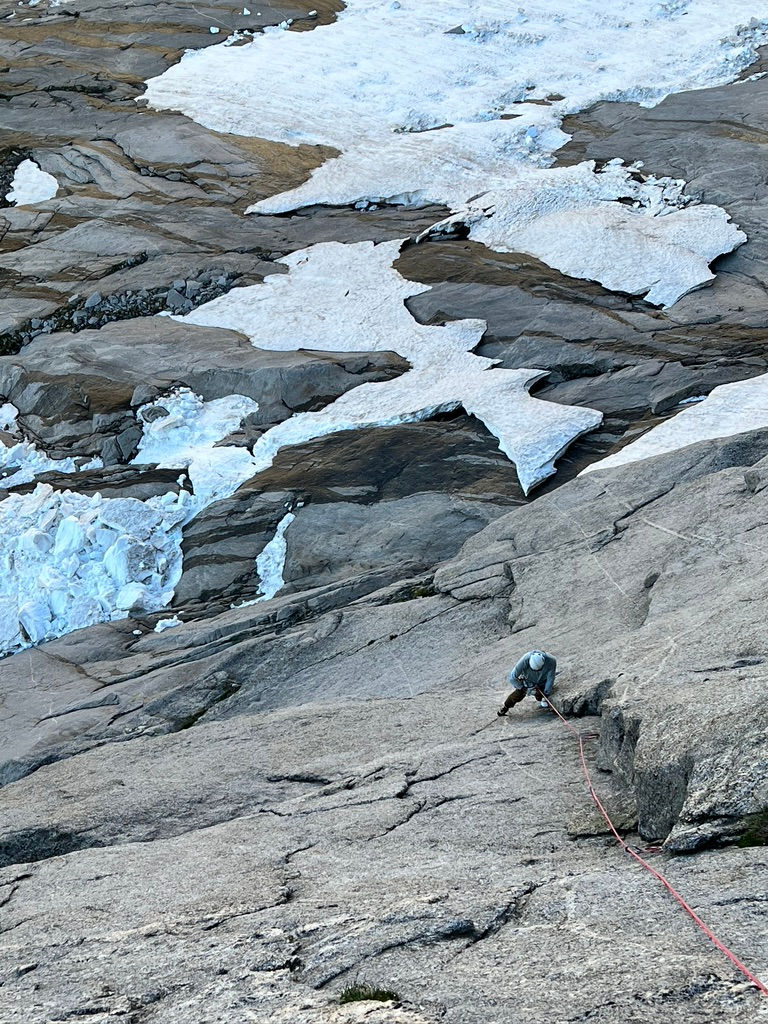
The morning was an early one, as was the norm on this trip, and we left camp by 4:45am or so. Driese-Kehoe is not as popular as some of the other routes in the cirque, so we had a bit of difficulty finding the true start of the route. There was also quite a bit of snow over on this side of the Wolf's head and it appeared that the true start was covered. We found an alternate start, just to the right side, and began heading up the route. The first 3 pitches of so were zig-zaggy and a bit runout, but followed some fun low angle cracks and flake systems. The route then started to steepen & the pitches became pretty damn fun. We climbed two 5.10 pitches, each unique and funky in their own way, before getting to the belay for the MEGA ROOF! We were super psyched after the first 5.10 pitches and felt baffled as to why this route wasn't more popular - it was really really fun. But the real fun was about to start! The crux of the route, and by far it's best pitch, is a gigantic 40ft roof traverse. We could see the roof from camp - it's one of the larger features on entire face and became more & more intimidating the closer we got. Isaac was psyched to lead it and felt it'd be a great pitch to push it beyond the comfort zone a bit. Although "only" 5.10, it was such a funky looking feature that we couldn't tell how difficult it would feel.

Being a dead-horizontal roof, placing gear would surely be more difficult than a vertical, parallel crack. Roofs like this tend to require smearing your feet on the lower face, sticking onto the wall by the oppositional force provided by pulling outwards, towards yourself, on the crack where the roof meets the face. This leaves you in an awkward position - the roof doesn't allow you to stand up straight & it's a constant battle between leaning back far enough that your feet have enough force & friction on the lower face to avoid slipping, trying not to hit your head on the roof, and finding the positions where you can shift your center of gravity closer to the wall to actually see if the gear you placed was good. In reality, this means blindly placing some pieces, moving to a better stance, and only then looking back to see if your gear was placed well. But there was no need to fear. Isaac has this personality trait where he feels that he isn't as strong or as competent as he truly is. I have similar feelings about myself in all aspects of life, not just climbing, so I strongly relate. But as his partner & after a whole summer of watching him breeze through alpine routes that were this hard, or harder, I knew he'd have zero problems.

Tangent: Finding a great climbing partnership is an elusive task, and one that can't be forced. It takes trust, time, and looks VERY different to everyone, one of the reasons why it's so elusive. Climbing with Isaac has been easy in many ways. He's extremely competent and skilled with rope management, anchors, gear, and he knows the many ways in which you can get yourself out of (and into) trouble. He also shares my obsession with efficiency, and there's rarely a moment of wasted time when we climb together. But most importantly, for me at least, is that I've never seen him get upset, angry, or let the stress of a situation lead to freak-out-mode. He's as even keeled as anyone I know and has an incredible ability to stay psyched and laugh when things get tough. When we were doing the traverse a few days prior, it felt like a serious day. The wind, the technical terrain, and the infinite rappels had us both on edge. But not once did he ever let the stress come into the partnership. All decisions we made were focused and well thought-out, even when we were fully aware that the both of us were anxious & a bit more scared than we anticipated. The best part about it was that once the stressful terrain was behind, we went right back to laughing our asses off about childish stuff & kept the mood at an all time high through the pain in our legs and serious fatigue. Long story short, Isaac has an energy & joy for climbing that makes the brutal, painful, and scary situations feel casual in the midst of these big days.

Back to the story... Isaac proceeded to cruise the pitch, as expected. He made it look so easy that I let my guard down when I should've been ready to focus. So after watching him waltz across the roof, I thought it was going to be an easy, enjoyable section. Turns out it was hard & Isaac really is the mega-crusher he won't believe he is (I hope you're reading this Isaac). I had a tough time with the footwork and ended up with most of my weight being supported by my biceps, a terrible strategy for such a long roof, but I eventually made it through and met Isaac at the belay. We were PSYCHED! It was an incredible pitch, made even more exciting by the lack of traffic. Smearing our feet through the roof was significantly less secure due to the rock quality & crumbly nature of the lesser climbed granite. We finished off the last few pitches, a plant-filled 5.10 finger crack & a squeezy slot, to the top!
The descent went much quicker than expected & turned out to be a pretty damn convenient way off of Wolf's Head. We were back down to the base of the South Face Right in no time and, with the energy levels feeling very high, immediately started up the route. There was another party on the upper pitches, so we forced ourselves to climb slowly & avoid a crowded belay. The timing was perfect and we hit the first belay not long after the party ahead had left it. We were linking pitches and ended up climbing the whole route in two long sections as opposed to four short ones. This route was another one for the books - amazing 5.10 crack climbing with a short, arching finger crack crux near the top. A great route to come back to & absolutely worth adding to the day if you're descending the East Ridge. We topped out, chatted with the party ahead (who were super psyched & super friendly) before heading back down the ridge once more.

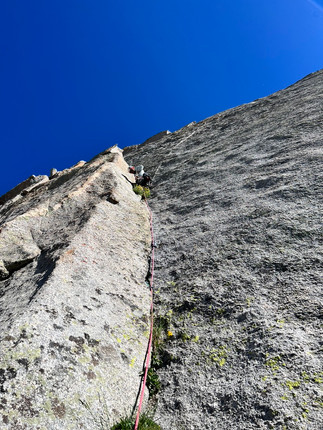


We'd had a big day already, but it was still quite early. Starting the day at 4:45am left us in an awkward position where we either stayed at camp, reading & festering from noon until bed time, or kept on climbing more stuff. We decided we'd better head back to camp, eat a snack & hydrate, and then see how we felt. Physics tells you that energy cannot be created or destroyed, but I don't think Isaac knows how to abide by the law of mass-energy conservation because the second we returned to camp the conversation had already begun about what we were going to climb next. Not an "if" question, but a "what". The creation of energy from nothing is another reason why Isaac is a truly great partner. Not only does he create it for himself, but he's going to give you that energy too whether you like it or not.

Next thing I knew, we were blasting our way over towards the base of Pingora in search of the starting ledges of the East Face Left Side route. I genuinely don't know where we were pulling energy from at this point because, looking back on it, we covered WAY more ground on this trip than our bodies should've been able to handle. This push to climb more was also spurred on by our food situation that I mentioned earlier. At this point, we were 100% certain we'd have to leave a day early, if not two. The traverse and the long days in general had required significantly more calories than we accounted for. Well, before we left we definitely thought about bringing more food but decided our packs were heavy enough already and we might as well just accept being a little hungry near the end. I wasn't prepared for how hungry I'd really feel...
But for now, we had a route to climb! We found the base of the route and I started off leading a large simul block that was probably around 5 to 6 pitches in length. We were each blasting music on our phones, zoned in, and flowing up hundreds upon hundreds of feet of cracks & flakes. It was a great route & it felt very low-stress. At this point, we were dialed in with our systems and each other and there was really no need for communication. We each knew the other would stop when they were out of gear, would be smart & thoughtful with safety measures, and would be able to handle unknowns on our respective leads blocks. This meant we could each climb non-stop, listen to music, and really get into the flow of things on this 1200ft route. My block ended when I ran out of gear & belayed Isaac up to me so he could take over. The first block was quite easy & went quickly, but this second block appeared to be much steeper. Isaac took off, heading for some steep crack systems. He took his time to ensure we were on route & that he had ample gear in case of a fall. After the first block, we both assumed the upper half would be a breeze as well, but it was honestly kind of tricky (especially for a 5.7+?!). After the brief steep section, we returned to the state of non-stop climbing and reached the summit a short 80mins after leaving the ground!

We high-fived, took in the view for a bit, and then started the descent back towards camp. On the hike down, we again found ourselves geeking out about our love for big days in the mountains. It's hard to beat the feeling when things go according to plan, especially in an environment where there are so many unknowns and plenty of variables that are out of your control. Back at camp, we took stock of the food. We had enough for one more full day plus an extra breakfast & three bars, not much to work with. Luckily, we'd had an absolute blast on the trip thus far and had done everything we came to do and more. this made our decision pretty easy: one more full day of climbing and then we'd hike out the morning after that, but the last day had to be a good one! We pulled out the guidebook and started searching for something we could both get behind. We had yet to climb a route up the face of Warrior I, and although we had summited on the traverse, the lack of routes on the face caught our interest
Day 7: East Face Left, Warrior l (5.10c, 10 pitches), hike out
Mountain Project isn't the most helpful resource in the Winds. For the ultra-classics, there's plenty of beta, photos, and route descriptions to ensure success on routes that could become a much more significant undertaking without the plentiful information. We climbed quite a few of these classics, but part of the fun that comes with alpine climbing is knowing less than you would at the local sport crag. Both of us, especially Isaac, are psyched on the long-term goal of developing big routes in inspiring places. We'd had a taste of this on Arrakis, an old aid route in Zion that had only seen one ascent and appeared to have potential to go free. Our good pal Jack Neus wrote a great report on our attempt, but long story short, we free climbed some large sections of the route, Isaac did some scary climbign in the depths of the night, got way in over our heads, and bailed before summiting. We learned a whole bunch of new skills, but also realized the difficulty and commitment that comes with trying to establish a new, long free route. We were pretty beaten down after that, but it got us pretty psyched for the process of developing the skills that are required for doing something like this. This is relevant because one of the ways we could "train" for these goals was by climbing alpine routes that, although developed and archived, had not seen many ascent and lacked information. This seemed to be a great way to ease into the feeling of being on completely new terrain while having the safety margin of knowing the routes had at least been climbed by someone, at some point, even if it was long ago.
EAST FACE LEFT, WARRIOR I (5.10C, 10 PITCHES)
From the ledge where NE Face goes right…
P1&2 300ft 5.6 - start up on left trending ledges to gain the base of the obvious corner system capped by a roof. We simuled here, but would go in ~2 pitches if broken up.
P3 160ft 5.9 - start up the corner going around the right side of the roof. Follow the plant filled cracks up the corner. We belayed about 30ft past a small ledge in the corner.
P4 180ft 5.10 - continue up the corner to where it steepens a bit. We found this steeper section to be the crux. Great gear when you find it, but you have to run it out a bit due to the plants in the corner. After this steep section the main corner continues - we opted to climb the flakes on the right side instead of the corner (no gear in the corner). The flakes, or corner, lead to a large ledge below a steep wide crack.
P5 180ft 5.9 immediately off the belay, 5.7 after those few moves - climb the steep crack and trend left after you pull the lip. This leads to a right trending ledge system which will take you all the way to the notch below the true summit.
P6 150ft 5.8 - maybe there are different options here, but we took the obvious steep hand/finger crack up the back side of the tower (climbers right when arriving at the notch). Climb about 60ft and then traverse the top of the tower to find the NE Face rappel route
---------------------------------------------------------------------------------------------------------------------------


Comments